
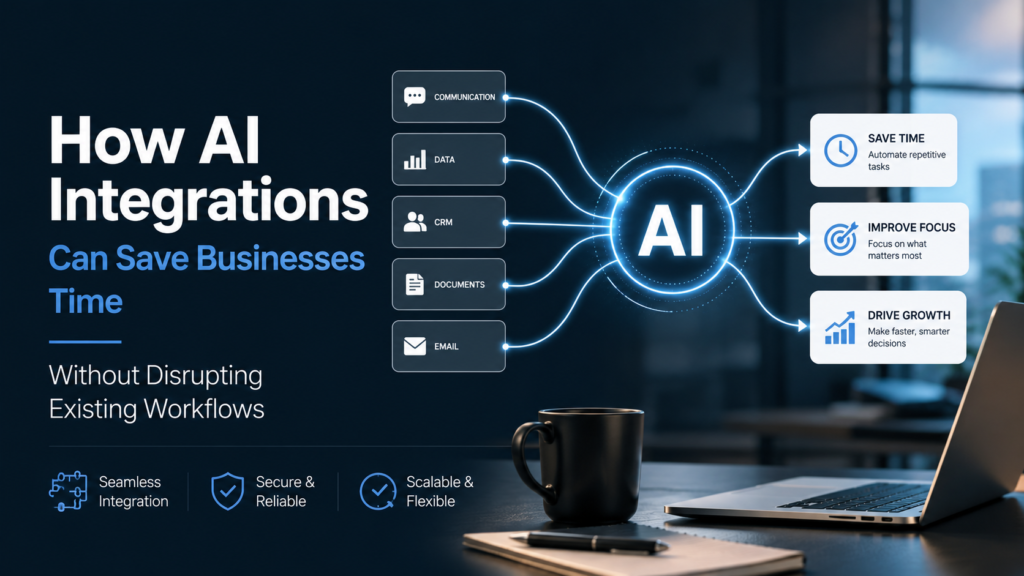
For many businesses, the interest in AI is already there. The hesitation usually comes from a different place. Leaders do not always wonder whether AI matters — they wonder whether adopting it will create confusion, require major restructuring, or introduce more complexity than value.
That concern is understandable. Many companies already rely on a patchwork of tools, internal processes, and team routines that may not be perfect, but still keep the business moving. The idea of adding AI can sound promising in theory and disruptive in practice. The good news is that useful AI integration does not have to mean tearing everything apart and starting over.
In many cases, the most effective AI work happens when it fits into the business quietly, supports existing workflows, and removes friction from processes that are already there.
Good AI integration starts with business reality
One of the most common mistakes companies make is starting with the tool instead of the workflow. They hear about a new AI platform, try to imagine how it might be used, and then force it into places where it does not naturally belong. That usually leads to poor adoption, fragmented processes, and disappointing results.
A better approach starts by looking at the business itself. Where is time being lost? Which tasks are repeated too often? Where do people copy information from one system to another, rewrite the same kinds of responses, or manually organize data that could be handled more efficiently?
When AI is introduced at those points, it feels less like a new layer of technology and more like a practical improvement to the way work already happens.
The goal is not replacement, but support
Many teams are wary of AI because they assume it will require a full operational shift or replace established methods overnight. In reality, the strongest business use cases are usually much more grounded. AI often works best as a support layer.
It can help draft routine outputs, organize incoming information, summarize long inputs, route tasks more intelligently, assist with structured communication, and reduce repetitive administrative effort. None of that requires a business to abandon its current systems completely. Instead, it allows teams to work faster inside the structure they already know.
This is an important distinction. Businesses do not need AI for the sake of novelty. They need it where it can reduce friction and improve consistency without making daily work harder to manage.
Small integration points often create the biggest value
A lot of companies imagine AI transformation as something large and dramatic. In practice, smaller integration points are often more valuable because they create immediate, visible wins.
For example, a service business may use AI to help process incoming requests more efficiently. A team handling repetitive documentation may use it to generate structured drafts. A company managing internal knowledge may use it to surface information faster. A sales process may benefit from better lead qualification support. A content workflow may become easier to maintain when AI helps organize initial outputs or repetitive formatting tasks.
None of these examples require rebuilding the entire business. They improve one part of the workflow at a time, and that is often the smarter way to adopt AI. It creates less resistance, lowers risk, and helps people trust the usefulness of the system because they can see the benefit directly.
AI should fit the workflow, not fight it
One reason some AI projects fail is that they are designed around what the technology can do in theory rather than how people actually work in practice. A workflow that looks efficient on paper may still fail if it interrupts daily habits, adds extra steps, or requires too much manual oversight.
That is why practical integration matters. The best AI systems fit naturally into the flow of work. They reduce unnecessary actions rather than adding new ones. They make processes feel smoother, not more technical.
When implemented well, AI can sit behind the scenes and improve speed, consistency, and clarity without constantly demanding attention. In many businesses, that is exactly what success should look like.
Better operations do not always require bigger systems
There is a tendency to assume that operational improvement must come from bigger platforms, more features, and more complex infrastructure. But that is not always true. Sometimes the better path is simply connecting existing systems more intelligently and reducing the manual work that happens between them.
AI can be especially useful in those in-between spaces. It can help bridge gaps between tools, support the movement of information, and reduce the repetitive effort that slows teams down. This makes it valuable not only as a standalone capability, but as part of a broader operational system.
For businesses that already have tools in place, this is often a more realistic and more cost-effective path than replacing everything with a new all-in-one environment.
The real value is operational clarity
The strongest result of AI integration is not always speed alone. Often, it is clarity. Teams spend less time on repetitive handling, less time guessing what happens next, and less time managing avoidable process friction. Work becomes easier to move through, easier to support, and easier to scale.
That is why the most successful AI integrations are usually the ones tied to very ordinary business problems. They improve tasks that happen every day. They help with processes that already matter. They make the business easier to run.
And that is what separates useful AI from performative AI. One creates headlines. The other creates operational value.
Final thoughts
AI does not have to arrive as a dramatic overhaul. In many businesses, the most effective approach is quieter and more strategic. It starts with existing workflows, identifies the parts that create the most friction, and uses AI to support those points in a practical way.
That is how businesses save time without disrupting everything around them. They do not begin with hype. They begin with process. And when AI is integrated that way, it becomes less of an experiment and more of a working part of the business.