
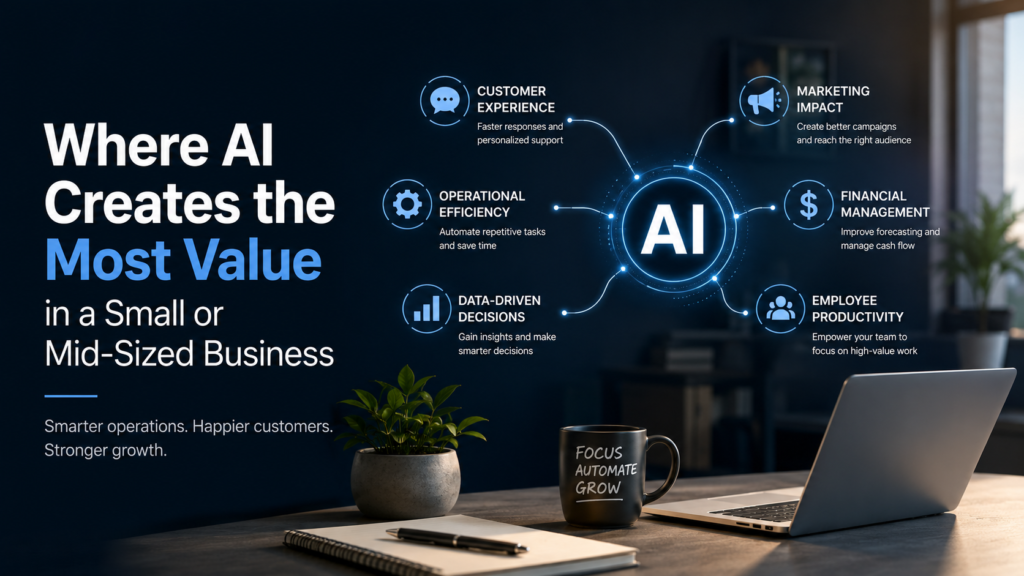
For small and mid-sized businesses, AI often sounds promising but vague at the same time. Most owners and operators already understand that AI matters, yet many are still unsure where it actually belongs inside a real business. The problem is not lack of interest. The problem is that AI is often discussed in broad, abstract terms instead of in relation to the daily work that keeps a company running.
In practice, AI creates the most value when it is applied to specific operational pressure points. These are usually the areas where teams repeat the same tasks, move information manually, answer similar questions over and over, or spend too much time organizing work that could be supported more intelligently.
For smaller businesses especially, this matters because time, attention, and staffing capacity are limited. When AI reduces friction in the right places, the impact is often felt immediately.
Internal workflows are usually the best place to start
One of the clearest areas for AI value is the internal workflow itself. Many companies lose time not because the work is too complex, but because the process around the work is too repetitive. Information has to be copied, summarized, reformatted, reviewed, or passed between tools and people in ways that consume energy without creating much additional value.
AI can improve these workflows by helping with structured outputs, summarization, routing logic, task support, and the handling of repeated process steps. This does not mean replacing the team. It means reducing the manual workload around the team so people can spend more time on decisions, service, and execution that actually require human attention.
For many businesses, this is the most practical entry point because the value is easier to measure and the workflow is already familiar.
Repetitive communication is another high-value use case
A large amount of business time disappears into repeated communication. Teams answer similar inquiries, send similar updates, request the same missing information, and restate the same process details in slightly different ways. None of this is unusual, but over time it becomes a quiet source of inefficiency.
AI can support this area by helping generate structured drafts, prepare responses, organize incoming requests, and make communication workflows more consistent. In some cases, it can also help classify messages or surface the next logical action so less time is spent manually sorting through routine interactions.
This is especially useful in service businesses, support-heavy environments, and companies where response time shapes customer experience directly. Better communication workflows do not only save time internally. They also improve the experience on the other side.
Knowledge handling becomes more important as a business grows
Small businesses often operate through informal knowledge. People know where things are, how tasks are done, and who to ask when something needs clarification. That works up to a point. But as a company grows, informal knowledge starts becoming a bottleneck. Teams waste time searching for answers, repeating explanations, and relying too heavily on a few individuals who hold too much process knowledge in their heads.
AI can create value here by supporting internal knowledge access, helping organize process information, and making structured answers easier to retrieve. When people can find the information they need faster, operations become less dependent on memory and constant interruptions.
For growing businesses, this type of support can be just as important as external automation because it strengthens the business from the inside.
Lead handling and early-stage qualification can be improved
Another strong use case is lead handling. Many businesses receive inquiries that vary widely in quality, clarity, and readiness. Some leads are well informed and close to making a decision. Others are vague, incomplete, or not well matched to the offer. Sorting through all of that manually can take significant time.
AI can help structure this stage by supporting lead intake, identifying patterns, organizing responses, and helping qualify opportunities more consistently. It can also help reduce the gap between incoming interest and the business’s ability to respond clearly.
For smaller teams, this matters because lead handling often competes with delivery work. If AI can reduce friction at the front end, the business becomes easier to manage overall.
AI is especially useful in the spaces between tools
One of the biggest hidden inefficiencies in small and mid-sized businesses comes from the gaps between systems. A company may already have decent tools in place, but the real problem happens in the transitions. Information gets copied from one platform to another. Teams manually re-enter data. Updates get lost between software environments. Process continuity depends on people remembering steps rather than on the system supporting them.
AI can create value in those in-between spaces. It can help connect tools more intelligently, reduce repetitive manual handling, and make workflows smoother without forcing the business to replace everything it already uses. This is one of the most practical reasons to think about AI as part of operations rather than only as a standalone tool.
When AI reduces the friction between platforms, the entire system starts working better.
The best use cases are usually ordinary, not flashy
One reason businesses struggle to identify where AI belongs is that public discussion often emphasizes the most dramatic examples. But the strongest value usually comes from much more ordinary use cases. AI is powerful when it improves the repeated, invisible work that slows a business down every day.
That may mean helping with document handling, communication support, information structure, workflow continuity, recurring tasks, or internal process assistance. These are not the most glamorous examples, but they are often the ones that create the clearest operational return.
For small and mid-sized businesses, that is good news. It means AI does not have to be adopted through large, risky transformation projects. It can begin where the business already feels the most friction.
Final thoughts
AI creates the most value in a small or mid-sized business when it is tied to real operational needs. Internal workflows, repeated communication, knowledge access, lead handling, and the space between tools are often the best places to look first.
The point is not to use AI everywhere. The point is to use it where it removes friction, saves time, and makes the business easier to run. When that happens, AI stops feeling like an abstract trend and starts becoming a practical part of everyday operations.